
| Driving Lessons In Irvine. | |
| Manual Driving Lessons. | |
| Contact Choices | |
| Mobile : | 07773 979907 |
| Email : | Dave |
| Online : | Lesson Enquiry Form |
| Facebook : |  |
| Twitter : |  |
| Review : | Post Your Driving Lessons Review On Google |
Kilmarnock: Portland Road to South Hamilton Street,
Irvine: Townhead to Mill Road, Fleming Terrace to Kilwinning Road.
The following is the Glencor Driving School instructor's interpretation of various junctions. Due to these being interpretations, they should not in any way be considered as legally binding.
Junction Descriptions For Kilmarnock and Irvine
Amanda Richardson of Kilmarnock, Driving Lesson Testimonial
I decided to choose David as an instructor after a couple of people I knew spoke highly of his teaching methods. I soon realised I was right to go by their recommendations as his lessons were always very informative, clearly explained and conducted in a calm manner. The time would always be used efficiently as he would focus on weaker areas until I felt confident in them, which helped me progress and go on to passing my test.
I decided to choose David as an instructor after a couple of people I knew spoke highly of his teaching methods. I soon realised I was right to go by their recommendations as his lessons were always very informative, clearly explained and conducted in a calm manner. The time would always be used efficiently as he would focus on weaker areas until I felt confident in them, which helped me progress and go on to passing my test.
NEVER assume that traffic in a one-way street will be travelling in one direction.
Have lost count of how many I have met!
Even met one trying to enter the M77 via an off slip road!!!
Have lost count of how many I have met!
Even met one trying to enter the M77 via an off slip road!!!
Townhead to Mill Road, Irvine
Townhead to Mill Road
The Junction at Townhead and Mill Road on Google Maps
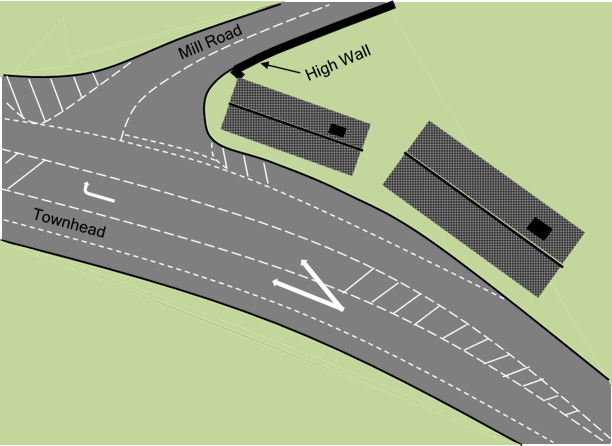
When turning right onto Mill Road it is important to travel up to the end of the safety zone before turning right. This will give a better view into Mill Road before attempting to turn.
When buses (or large vehicles) approach the end of Mill Road they move out across the centre line so as to avoid the high wall which is postioned next to the road edge.
For this reason it might be better to wait in the safety zone until the bus (or large vehicle) positions back into the left after it passes the end of the wall.
Also, because of this issue with the wall and large vehicles AND the not so clear view on approach it is quite often better to prepare to turn in 1st gear rather than 2nd gear.
When turning left out of Mill Road be aware of the kerb on the left. I have seen a lot of drivers hitting this kerb with the back wheel of their car due to turning too soon. Just make sure (as you should do for all junctions) that you drive forward enough before turing into the corner to turn left.
Gary Seton of Moscow, Driving Lesson Testimonial
Great instructor. Doesn't rush you but doesn't waste time either.
Great instructor. Doesn't rush you but doesn't waste time either.
Fleming Terrace to Kilwinning Road, Irvine
Fleming Terrace to Kilwinning Road
The Junction at Fleming Terrace and Kilwinning Road on Google Maps
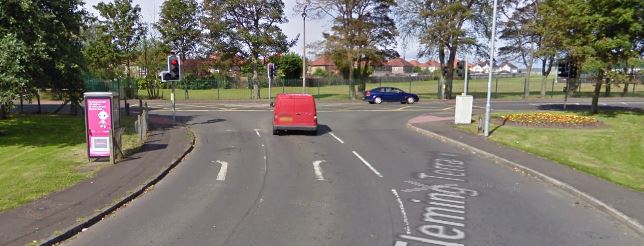
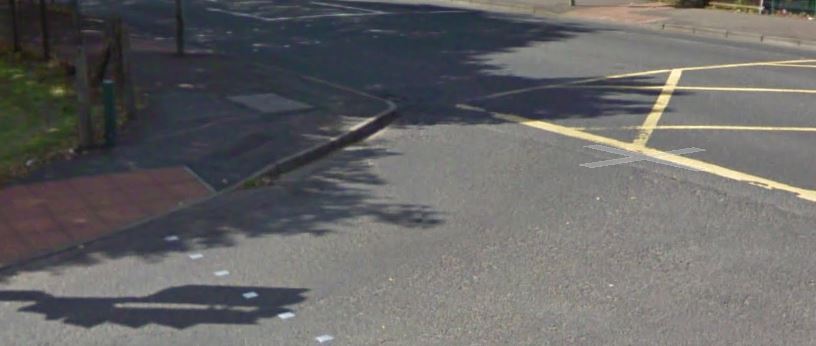
When turning left onto Kilwinning Road it is particularly important to be aware of the shape of the left kerb and therefore travel forward sufficient, before turning, so as to avoid hitting the kerb.
Paul McMaster of Crosshouse, Driving Lesson Testimonial
I would like to thank David for teaching me how to drive. With Glencor Driving School I passed within 4 months and it was all to do with David being patient and making me calm and confident when in the car. I have recommended some of my friends to Glencor. Thanks again.
I would like to thank David for teaching me how to drive. With Glencor Driving School I passed within 4 months and it was all to do with David being patient and making me calm and confident when in the car. I have recommended some of my friends to Glencor. Thanks again.
Portland Road to South Hamilton Street, Kilmarnock
Portland Road to South Hamilton Street
The Junction at Portland Road and South Hamilton Street on Google Maps
Nikitta Manson of Kilmarnock, Driving Lesson Testimonial
Before I started driving with Dave I had a previous instructor who had no patience at all, I then changed to Dave after many recommendations and it was the best choice I made. He is so understanding and calm. I would definitely recommend him if you're looking to pass well and become a confident driver.
Before I started driving with Dave I had a previous instructor who had no patience at all, I then changed to Dave after many recommendations and it was the best choice I made. He is so understanding and calm. I would definitely recommend him if you're looking to pass well and become a confident driver.
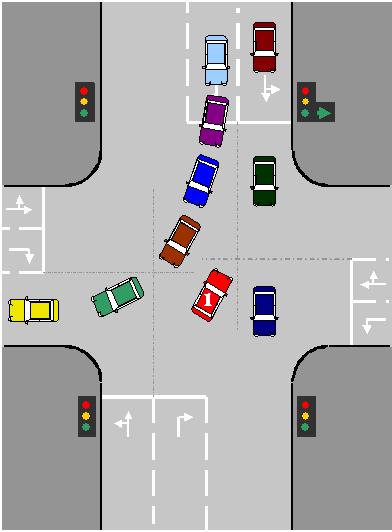
For this junction it is important to move into the correct position for turning right when approaching along Portland Road.
Note the position taken up by the red(1) car while waiting for a gap to turn. The diagram has lines added to show how to judge your position using the white lines of the oncoming lanes and the lanes to your right.
While in this position the red(1) car is not in the way of the oncoming cars that are turning to their right and not in the way of the oncoming cars that are traveling ahead.
Also, in this position the driver of the red(1) car can more easily see past the oncoming cars that are turning to their right therefore more able to assess when there will be a safe gap to turn.
This junction also has a green filter arrow which, only at certain times, illuminates after the green circle has been on for a designated period of time. When this happens, the oncoming traffic receive a red light therefore when they slow to stop the red(1) car should turn if the junction is now clear.
If your signal cancels before you turn, then switch it back on.
Terms and Conditions
Privacy Policy